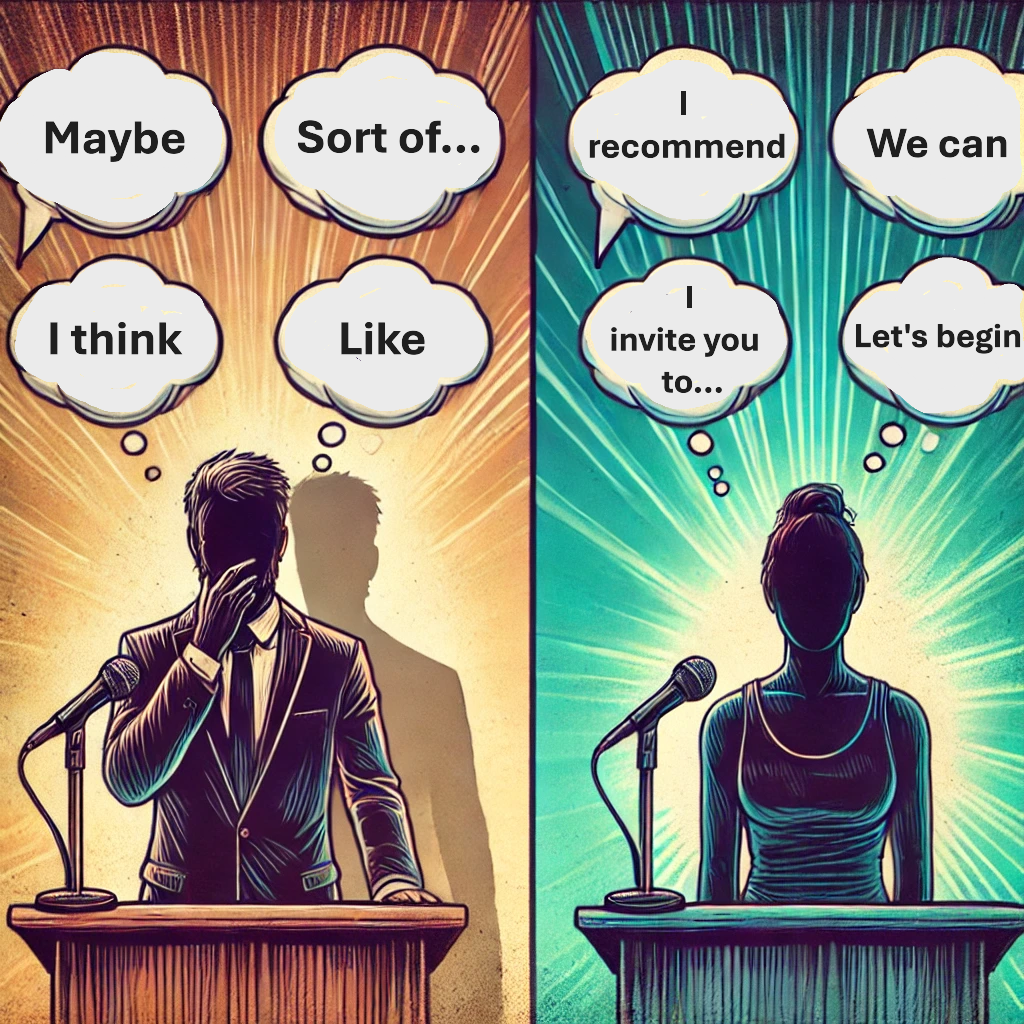
Ever watch a charismatic speaker command the attention of the room and wonder how they do it? Your success on a stage, in a meeting, or in everyday conversation relies not only on what you say, but how you say it. Public speaking and interpersonal communication are highly influenced by word choice, tone, sentence structure, and vocal delivery. Many of us unwittingly undermine our own performance through weak language patterns and vocal habits that reduce clarity, authority, and impact.
I’ve found seven common speech habits that make you sound weak. But, don’t stop reading now! Accompanying each bad habit, you’ll also find my best practical advice on how to eliminate and replace the hampering effect of these habits with stronger and more persuasive speech patterns.
1. Run-On Sentences: Clear as Mud
The Problem: Run-on sentences occur when two or more independent clauses are improperly connected without appropriate punctuation or conjunctions. In spoken language, this often takes the form of a meandering sentence that tries to pack in too many thoughts without pause.
Why It Matters: Listeners rely on pauses and sentence boundaries to process meaning. Run-on sentences create cognitive overload and signal disorganization, making it difficult for audiences to follow your train of thought.
Research Insight: According to Kellermann and Reynolds (1990), clear segmentation of ideas improves recall and comprehension in listeners. Effective speakers break information into digestible “idea units,” while those who over-pack sentences see reduced engagement and message retention.
Fixing the Habit:
- Plan your structure. Think in short, impactful sentences.
- Pause intentionally. Break longer thoughts into smaller, complete ideas.
- Use transitions. Words like next, because, therefore, or however signal shifts, helping audiences follow.
Example: ❌ “So we started the project and then we had to deal with some issues, and it was just really complicated and maybe we should have planned more, but now we’re trying to fix it.”
✅ “We launched the project. Some unexpected challenges came up. In hindsight, better planning could have helped. Now, we’re working on solutions.”
2. Lack of Direction: Wandering Without a Map
The Problem: Speaking without a clear point or structure is often caused by thinking aloud, digressions, or starting sentences without knowing where they’re going.
Why It Matters: Listeners want to know where you’re taking them. If your point is buried or nonexistent, they lose interest or confidence in your message.
Research Insight: A study by Beebe and Beebe (2012) found that structured messages with a clear introduction, body, and conclusion lead to significantly higher audience ratings of speaker competence and persuasiveness.
Fixing the Habit: In one of my previous blog posts, “Super-influencer or boring beyond belief?” I emphasized the practice of thinking about what we want our target audience to think, say or do as a result of our communications, before we communicate. Tactically speaking, we need outline our thoughts and bring the listener along as you get to your point. Instead of building to a conclusion, speak like a news article and start with your headline. Once you’ve earned their attention, then give a few short, supportive examples. You can also use signposts or flags like “Let me explain why this matters” or “The key takeaway is…” to guide listeners.
Example: ❌ “I was thinking about how things are kind of not working, and maybe it’s because we didn’t try hard enough at first, or maybe it’s something else, but anyway…”
✅ “Here’s the issue: our current strategy isn’t working. I believe this stems from early misalignment, and I’ll explain how.”
3. Conditional Language: The Language of Hesitation
The Problem:
Words like should, could, might, maybe, and perhaps convey uncertainty. While these words have a place in nuanced discussion, overusing them in speech weakens your authority and signals indecisiveness.
Why It Matters:
Audiences look to speakers for direction and confidence. Conditional language creates ambiguity and dilutes the strength of your argument or proposal.
Research Insight: Linguist Deborah Tannen (1990) notes that women, in particular, are socially conditioned to use “softeners” like just, maybe, or kind of to avoid appearing too assertive—yet these modifiers can undermine credibility in professional or public speaking settings.
Fixing the Habit:
- Identify and replace weakening words.
- Should ➝ will
- Could ➝ can
- Maybe ➝ I believe or I recommend
- Just ➝ often unnecessary—remove it
- Commit to your message. Even if you’re exploring options, phrase your thoughts as clear preferences or actions.
Example: ❌ “We could maybe try a different approach, or we might want to just leave it for now.”
✅ “I recommend we take a different approach. It’s more aligned with our goals.”
4. Passive Voice: Hiding the Actor
The Problem: Passive constructions obscure the subject doing the action. For example, “The report was written” doesn’t say who wrote it. This lack of clarity can sound evasive, bureaucratic, or impersonal.
Why It Matters: Active voice is more engaging and authoritative. It centers responsibility and makes communication more direct.
Research Insight: Williams and Colomb (2010) found that active voice improves readability and accountability in professional communication. In speech, it also boosts perceived leadership and clarity.
Fixing the Habit: Identify passive verbs. Look for forms of it followed by a past participle (was done, is being managed).
Rephrase to active voice. Place the subject at the start.
Example: ❌ “Mistakes were made during the rollout.”
✅ “Our team made mistakes during the rollout.”
5. Rising Intonation: Making Statements Sound Like Questions
The Problem: Ending a declarative sentence with a rising tone—a habit known as “uptalk”—makes it sound like a question, even if it isn’t one.
Why It Matters: Rising intonation can convey uncertainty or a need for validation. It weakens statements that should project confidence.
Research Insight: According to a study by Levon (2016), rising intonation in professional speech settings is frequently interpreted as a lack of confidence, particularly in women, though men are not immune. In contrast, falling intonation signals decisiveness and leadership.
Fixing the Habit:
Record yourself speaking. Notice where your intonation rises.
- Practice ending statements with a downward tone. Emphasize the last word with finality.
- Use pitch control exercises. Vocal coaches recommend marking the “drop point” of a sentence to anchor it.
Example: ❌ “I think we should move forward with the proposal?”
✅ “I think we should move forward with the proposal.”
6. Weakening Fillers and Modifiers: Stop Saying “Just,” “Like,” and “Sort Of”
The Problem: Words like just, like, kind of, and sort of are filler words and hedges. While common in informal speech, overuse makes communication less assertive and less clear.
Why It Matters: These words suggest that you’re minimizing your ideas or apologizing for speaking. This can erode your credibility and make your message harder to take seriously.
Research Insight: A Stanford University study (Bradac et al., 1990) on speech credibility found that frequent use of qualifiers and hedging language significantly reduced perceived speaker competence and trustworthiness. Other studies indicate that some types of filler words are associated with younger generations which tends to convey a lack of experience, credibility and even authority (Acton, 2011; Barbieri, 2008; Laserna et al., 2014; Tagliamonte, 2005).
Fixing the Habit:
- Notice your go-to filler words. Everyone has them.
- Practice pausing instead. Silence is more powerful than weak language.
- Rehearse cleaner phrasing. Use precise words that convey your intent.
- Use a smart phone app, such as LikeSo, to practice and reduce reliance on such crutch words. I have used LikeSo in the past and found it effective.
Example: ❌ “I just wanted to kind of check in and see if maybe you liked the idea?”
✅ “I’m checking in to see what you think of the idea.”
7. Presenting Ideas as Statements, not Questions
The Problem: Many speakers use question intonation or actual questions to suggest ideas. For example, “What if we did it this way?” instead of, “We should do it this way.” While sometimes appropriate in brainstorming, this pattern can suggest a lack of conviction.
Why It Matters: Leaders and persuasive communicators speak with declarative clarity. Turning statements into questions invites debate or dismissal—even when you don’t want it.
Research Insight: The Harvard Business Review (Cuddy, Kohut, & Neffinger, 2013) links confident nonverbal and verbal cues—like assertive statements—to higher perceived authority. Phrasing statements as questions signals submission or hesitation.
Fixing the Habit:
- Trust your judgment. Don’t ask for permission to state your ideas.
- Rephrase questions as statements.
- Use questions intentionally. Ask them only when seeking input, not when presenting direction.
Example: ❌ “What if we scheduled the launch for next Monday?”
✅ “Let’s schedule the launch for next Monday.”
Putting It All Together: Strong, Clear, Confident Speech
Let’s compare a “before and after” example that incorporates all of the guidance provided:
Before: “So, I was thinking maybe we could kind of start the campaign earlier? I mean, it might be better, I guess, just so we’re ahead of schedule, you know? But I’m not sure if it would work.”
After: “I recommend we start the campaign earlier. It will keep us ahead of schedule and give us time to adjust if needed.”
Notice the difference? The revised version is:
- Direct and concise
- Free of fillers and hedging
- Structured with a clear recommendation
- Delivered as a statement, not a question
- Presented with confidence
________________________________________
Action Plan: How to Build Better Habits
Changing the way you speak takes intention and practice. Here are strategies to solidify your improvement:
1. Record and Review: Listen to recordings of your presentations or conversations. Identify patterns like uptalk, filler words, or vague phrasing.
2. Write It Out: Before speaking, write key ideas in strong, active language. Practice delivering them aloud.
3. Practice With a Partner: Get feedback from a trusted colleague or coach. Ask them to note when you hedge, ramble, or soften your message.
4. Use an App: Use an app such as LikeSo to engage in exercises to reduce your use of filler words.
5. Use Power Posing and Breath Control: As Amy Cuddy’s research has shown, your physical posture affects vocal delivery. Stand tall, breathe deeply, and speak with intention.
6. Embrace the Pause: Instead of filling silence with weak words, pause. It adds weight to your words and gives you time to think.
Conclusion: Speak as You Mean It
Strong communication isn’t about using complex vocabulary or speaking louder; it’s about being intentional with your words, tone, and structure. By eliminating weak language patterns like run-on sentences, vague phrasing, passive voice, and hedging modifiers, you present yourself as confident, credible, and compelling.
Whether you’re speaking to a crowd or one-on-one, your voice matters. Make it count. Speak with purpose. Drop the “maybes” and “sort ofs.” Own your statements. Because when your language is strong, people listen.
# # #
 jcs-communications.com
Leave a comment